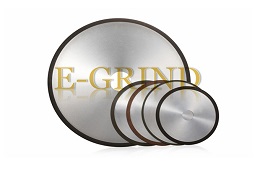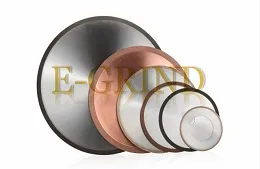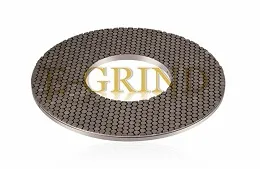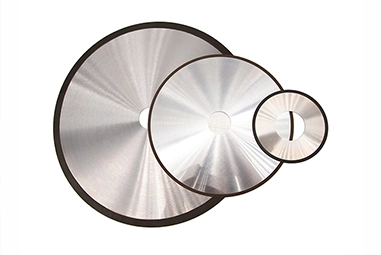
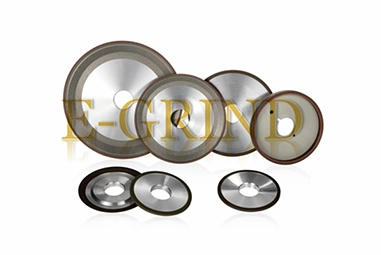
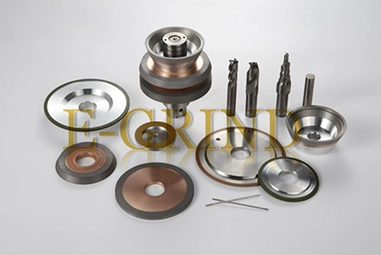
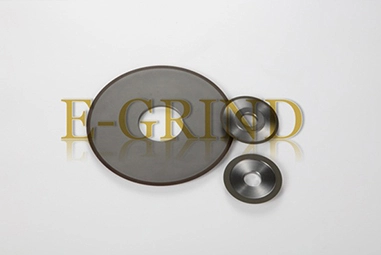
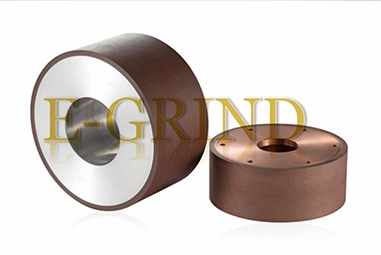
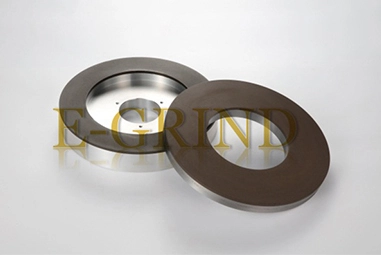
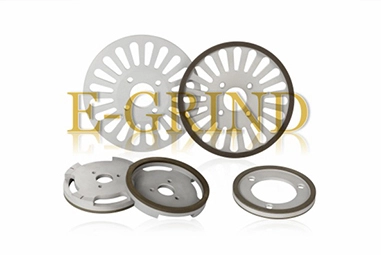
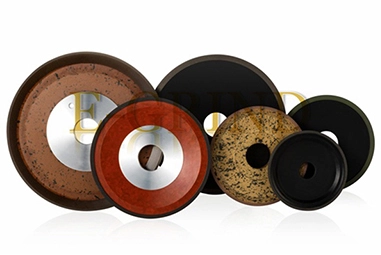
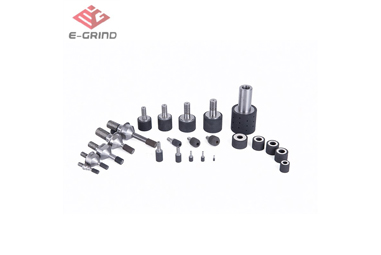
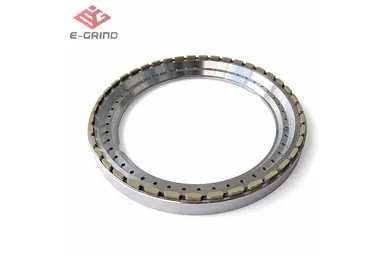
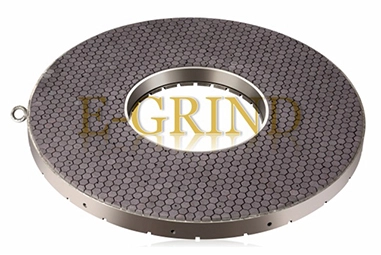
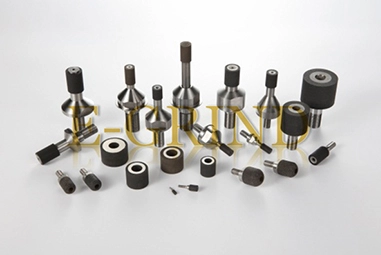
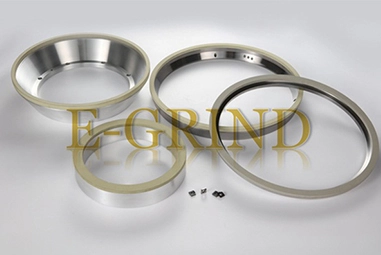
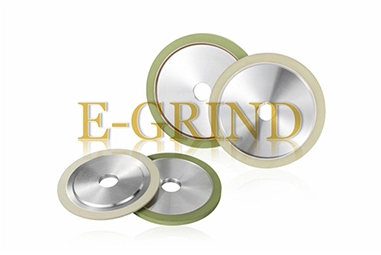
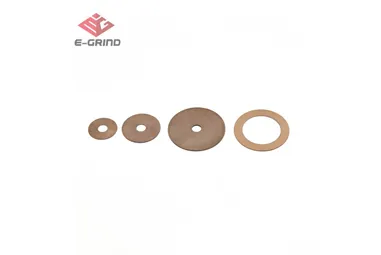
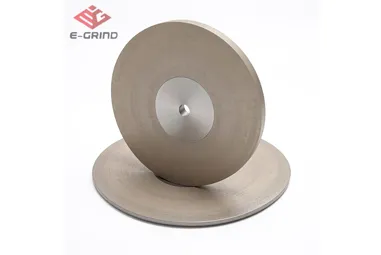
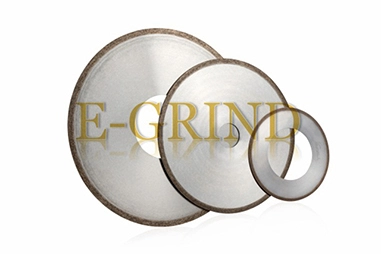
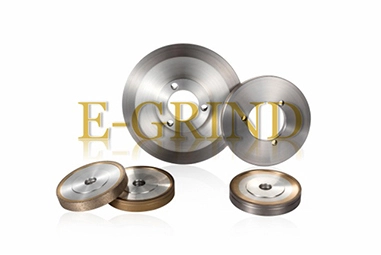
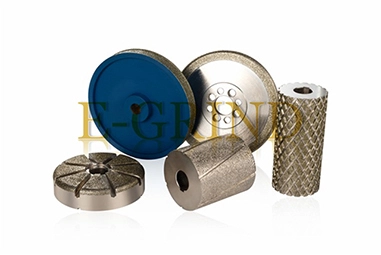
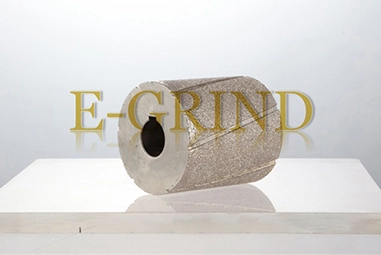
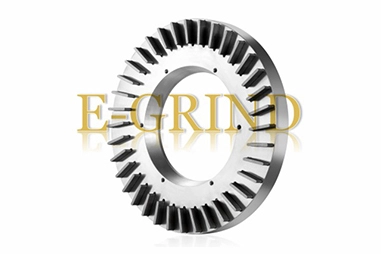
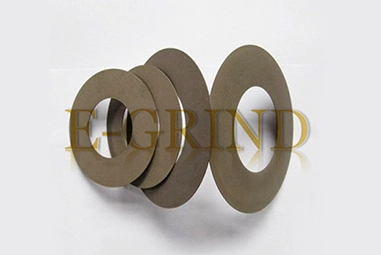
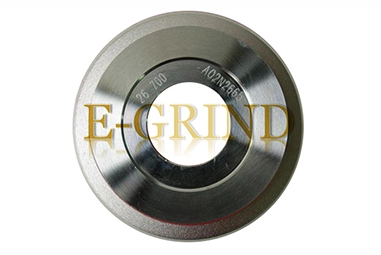
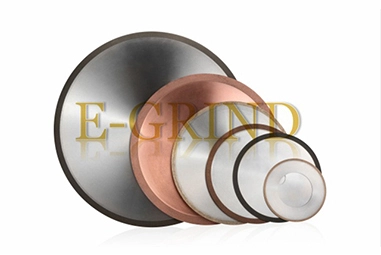
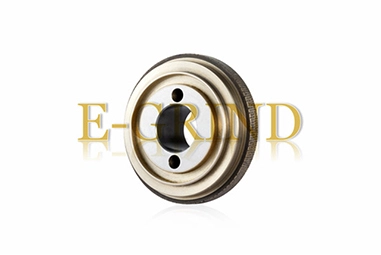
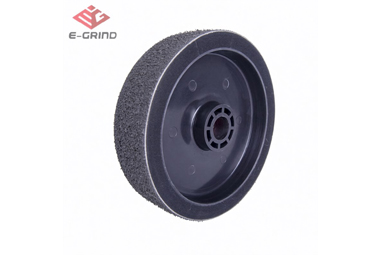

A CBN vitrified bond wheel uses Cubic Boron Nitride (CBN) superabrasive grains bonded in a glass-like (vitrified) matrix. Its key advantages are exceptional thermal stability for high-speed grinding, free-cutting action, and the ability to be dressed/trued to precise form. It's the premier choice for grinding hardened steels, superalloys, and high-speed tool steels, offering superior surface finish and dimensional control.
What is a CBN vitrified bond grinding wheel, and what are its key advantages?
What are the main applications of resin bonded grinding wheels compared to other bonds?
Resin bonded wheels (with diamond or CBN) excel in applications requiring high stock removal, shock absorption, and cool cutting. They are ideal for carbide tool grinding, rough grinding of ceramics, and dry grinding operations where their flexible bond reduces heat generation and workpiece burn. Compared to vitrified or metal bonds, they offer faster cutting but generally shorter lifespan.
How do I select a reliable centerless grinding wheels supplier for high-volume production?
Choose a centerless grinding wheels supplier based on: Consistent lot-to-lot quality control (critical for size holding), technical expertise in regulating wheel and workpiece roundness, custom formulation capabilities for specific materials, and responsive support for troubleshooting. Look for suppliers specializing in superabrasive solutions for centerless grinding of pins, shafts, and bearing components.
What are dicing blades (disco blades) used for in semiconductor and electronics manufacturing?
Dicing blades (disco blades) are ultra-thin, diamond-embedded blades used for precision dicing, slicing, and grooving of brittle materials. They are essential in manufacturing for singulating semiconductor wafers into individual chips (die), cutting ceramic substrates, optical glass, and advanced composites. Their specification defines the precision and quality of the final micro-components.
What is unique about cam grinding wheels, and why is profile accuracy critical?
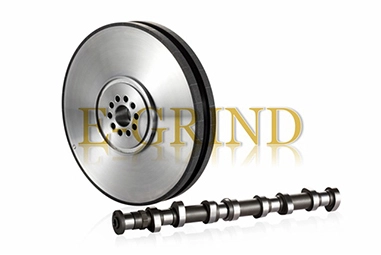
Cam grinding wheels are custom-shaped wheels used to grind the complex, non-circular profiles of engine camshafts. Their uniqueness lies in the precise grinding surface that is formed onto the wheel via diamond dressing rollers. Profile accuracy is critical because any deviation directly affects engine valve timing, lift, and overall performance.
How do electroplated grinding wheels work, and what are their benefits and limitations?
Electroplated grinding wheels have a single layer of diamond or CBN grains chemically bonded (plated) onto a metal hub. Benefits include extremely sharp cutting edges, high protrusion for deep grooves, and no need for dressing. Limitations are non-reusability after grain wear and typically shorter overall life compared to multi-layer bonded wheels. They are perfect for form grinding, slotting, and profiling complex shapes.
What factors determine the choice between a diamond grinding wheel and a CBN wheel?
The choice is material-driven:
Diamond Grinding Wheel: Use for non-ferrous, brittle, and high-hardness materials like tungsten carbide, ceramics, glass, and stone. Diamond reacts chemically with ferrous metals (iron), causing rapid wear.
CBN Wheel: Use for ferrous and high-tensile-strength materials like hardened steel, tool steel, superalloys (Inconel), and cast iron. CBN is thermally and chemically stable on these materials.
How do resin bonded diamond grinding wheels differ from metal bonded diamond grinding wheels?
Resin bonded diamond wheels are softer, more flexible, and cut faster with cooler operation, ideal for fine finishing and sharpening. Metal bonded diamond wheels are harder, more wear-resistant, and hold form longer, ideal for precision grinding, slicing, and applications requiring high dimensional stability, like wafer dicing and optical grinding.
What are the major classifications of grinding wheels based on abrasive and bond type?
The primary classification of grinding wheels includes:
By Abrasive: Conventional (Aluminum Oxide, Silicon Carbide) vs. Superabrasive (Diamond, CBN).
By Bond: Vitrified (V), Resin (B), Metal (M), Electroplated, and Hybrid bonds.
By Structure: Dense to open (grain spacing).
By Grade: Soft to hard (bond strength).
When would I choose an electroplated diamond grinding disc over a sintered metal bonded grinding disc?
Choose an electroplated diamond grinding disc for aggressive stock removal on flat surfaces, beveling edges, or grinding in hard-to-reach areas where a thin, flexible disc is needed. It's great for one-off jobs, weld removal, and contour work. Choose a sintered metal bonded disc for long-duration, precision flat grinding where consistent thickness and long life are paramount.
What specifications are critical when reading a disco blade (dicing blade) datasheet?
Critical disco blade specifications include:
Abrasive: Diamond type/grade.
Grit Size (Mesh): Determines cut finish.
Concentration: Diamond density.
Bond Type: Metal, resin, or electroformed.
Thickness & Outer Diameter: Defines kerf and machine compatibility.
Hub Design & Bore: Mounting specifications.
Our datasheets provide all details to ensure perfect blade-to-application matching.
What is a back grinding wheel in the context of semiconductor manufacturing?
A back grinding wheel is a specialized, ultra-fine diamond wheel used to thin silicon wafers from the backside after circuitry is built on the front. This process, called wafer thinning, reduces chip thickness for stacking (3D packaging) and improves thermal performance. It demands exceptional flatness, surface finish, and minimal sub-surface damage.
What is the function of a diamond dressing roller, and how is it used?
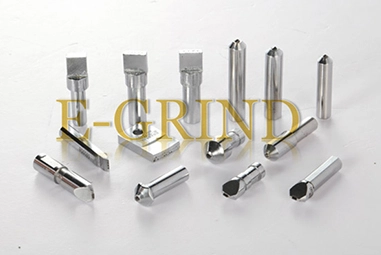
A diamond dressing roller (or form roller) is a tool used to true and profile conventional and superabrasive grinding wheels. Its surface is embedded with diamond particles. As it rotates against the grinding wheel, it accurately replicates its inverse profile onto the wheel, restoring its cutting geometry and shape for precision form grinding operations like cam or gear grinding.
What are the key characteristics and uses of metal bonded grinding tools?
Metal bonded grinding tools (wheels, discs, bits) feature diamond/CBN grains in a sintered metal matrix (cobalt, bronze, iron). Key characteristics are extreme wear resistance, excellent form retention, and long life. They are primarily used in ultra-precision grinding, slicing of hard materials, glass/ceramics machining, and electrolytic grinding.
Can I use a die grinder diamond wheel for grinding carbide, and what type is best?
Yes, die grinder diamond wheels are excellent for shaping, sharpening, and grinding tungsten carbide tools and tips. For use on a high-speed air or electric die grinder, an electroplated diamond wheel is typically best. It provides a fast, cool cut. Choose a coarser grit (100/120) for shaping and a finer grit (200+) for finishing. Ensure the wheel’s rated RPM exceeds your tool's speed.
Why use Diamond and CBN Grinding wheels?
Diamond and CBN are defined as super hard materials due to their extreme hardness that surpasses the traditional abrasive materials like alumina oxide or silicon carbide.
Diamond and CBN Wheels are widely used in highly effective grinding processes and offer substantial benefits over traditional wheels.
The main advantage of diamond and CBN wheels:
Very long tool life and profile stability
Short grinding times
Short handling times
Lack of thermal damage to the workpiece
Ensure appropriate workpiece quality
How do I mount and true diamond & CBN wheels?
The correct installation and dressing of resin diamond grinding wheels are crucial for ensuring their performance and service life.
Installation:
Verify the grinding wheel information to ensure it meets the operational requirements.
Inspect the grinding wheel’s appearance to ensure it is damage-free.
Assemble the resin bond diamond wheel onto the spindle freely, avoiding excessive force.
Use a flange to securely clamp the grinding wheel, ensuring stable clamping with uniform pressure distribution.
Use a standard wrench for tightening, avoiding the use of an extended wrench or hammering.
Dressing:
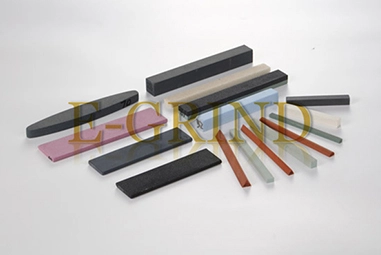
Dressing can be done using a conventional abrasive grinding wheel.
During dressing, the diamond grinding wheel rotates while the conventional abrasive grinding wheel rotates and feeds simultaneously.
Monitor the conventional abrasive grinding wheel’s wear during dressing and replace it promptly when necessary.
Maintain appropriate dressing pressure and speed.
How to choose superabrasives type?
Diamond applications
Diamond is the hardest abrasive material in the world.
Its hardness, wear and thermal resistance made the diamond the most appropriate abrasive to machining such materials as:
Hard metal
Cermet
Hard metal/steel combinations
Glass
Quartz
Ceramic materials of all kinds
Ferrotitanite
Carbide-based powder coating
Graphite
Polycrystalline diamond and CBN blanks
Ceramic magnetic materials
Glass and carbon-fiber reinforced synthetic materials
Tungsten Carbide
CBN applications
CBN is the second material after diamond. CBN is produced similarly to the diamond by high pressure and high-temperature aynthesis. Due to their chemical features and considerable lower wear, CBN tools are used for grinding such hard-to-process steels as:
HarHardened high-speed steel (HSS)
High alloyed steels with at least 55 HRC
Case-hardened steels
Iron-based powder coatings
Chill castings
Soft steels in certain applications
Stellite
CDX applications
CDX is a special superabrasive material with the performance between diamond and CBN. It is mainly used to grind the compound of hard&fragile material (like TCT) and Ferrous material (like Chilled steel).
How to choose Diamond and CBN grit size?
The chosen grit size affects the performance of the wheel determining the stock remove rate and surface finishing that can be achieved coarser grit size enables a higher material removal rate and rougher surface finishing, while a fine grit size is used for attaining a smoother surface finishing.
How to Truing and Dressing?
Truing and Dressing are necessary for keeping your super abrasive grinding wheel in ultimate working condition.
Truing gives the grinding wheel its geometrical accuracy and makes it run true while dressing opens up the grinding wheel, and exposes the abrasive grit by clearing away bond material from around the cutting edges.
Do I have to use coolant on my grinding wheels?
While coolant plays a crucial role in the grinding process with grinding wheels, there are certain specific circumstances where the use of coolant may not be necessary. Here are some situations where coolant can be omitted:
1. Dry Grinding: In certain applications, such as dry grinding, coolant may not be used. Dry grinding is primarily used in situations where the surface quality requirements for the workpiece are not high, or the workpiece material is not susceptible to thermal damage. However, it should be noted that dry grinding may generate more heat and grinding swarf, causing greater wear on the grinding wheel and workpiece.
2. Specific Grinding Wheels: For some certain grinding wheels, such as those with special resin binders, have self-lubricating properties that can reduce friction and heat generation to a certain extent, thus eliminating the need for coolant. However, this situation is relatively rare and still requires evaluation based on specific conditions.
3. Short-Duration Grinding: For very short time grinding operations, such as removing minor defects or performing quick trimming on the workpiece surface, the use of coolant may not be necessary. This is because the heat generated during short time grinding is limited and unlikely to cause significant thermal damage to the workpiece.
4. Special Process Requirements: In some special process requirements, where maintaining certain characteristics of the workpiece surface (such as hardness, color, etc.) from being affected by coolant is necessary, coolant can be omitted. However, in such cases, it is important to ensure that the heat generated during the grinding process does not adversely affect the workpiece.
It should be emphasized that, despite the possibility of omitting coolant in certain situations, it is generally recommended to use coolant to ensure grinding effectiveness, workpiece quality, and extended grinding wheel lifespan. Especially in high-precision grinding, heavy-duty grinding, or long-duration grinding, the use of coolant is indispensable. Therefore, in practical operations, a balance and choice should be made based on specific conditions and requirements.
How to maintain abrasive grinding wheels?
Grinding wheels play a crucial role in machining processes, so their maintenance is particularly important. To ensure the long-lasting use and efficient grinding of grinding wheels, we need to regularly inspect them to ensure their surfaces are free of cracks, damage, or irregular wear. At the same time, maintaining the sharpness of the grinding wheel is also crucial. As processing time increases, the grinding wheel will gradually wear down, reducing its cutting ability. At this point, it is necessary to dress the grinding wheel to restore its sharpness.
Furthermore, when the grinding wheel wears to a certain extent or shows severe irregular wear, cracks, or other issues, it should be replaced immediately to avoid affecting processing quality and safety. When replacing the grinding wheel, we should ensure that the machine is powered off and follow the machine operation manual to correctly remove the old grinding wheel and thoroughly clean the installation area.
In addition to the above measures, proper storage of grinding wheels is also part of their maintenance. We should ensure that grinding wheels are stored in a dry, well-ventilated environment free of corrosive gases, avoiding moisture, heat, or contamination.
Finally, standardized operation is also an important aspect of grinding wheel maintenance and care. We should strictly follow the machine operating procedures for grinding operations, avoiding excessive grinding pressure or incorrect operating angles.